

Inner Ugly
A story about sequins and secrets

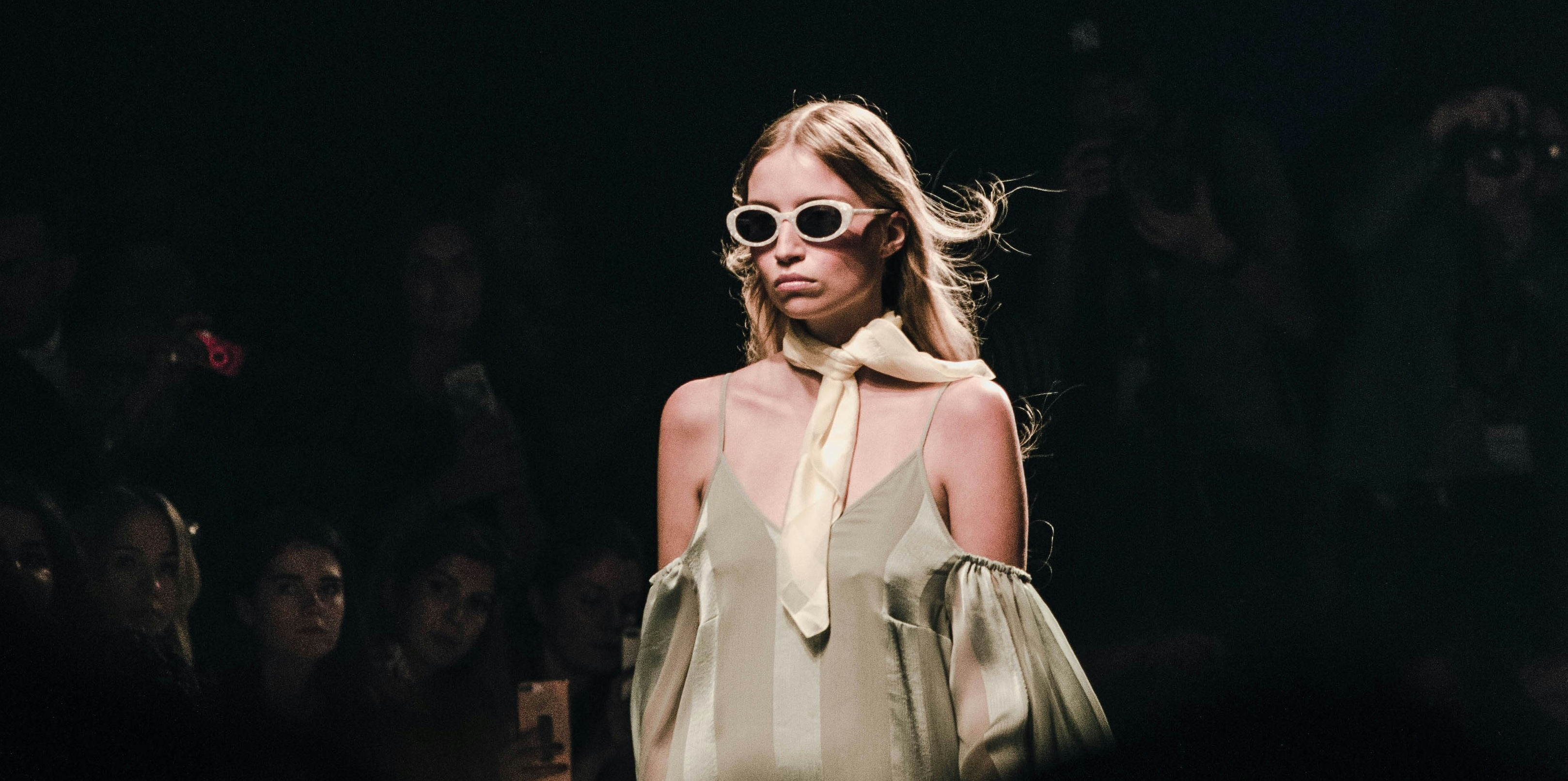
PARIS – Always a controversial designer, Elizabeth de Jong’s new runway show, “Autobiography,” revealed more than this particular correspondent expected. On several occasions, quite literally.
Nudity is nothing new in fashion shows. The frisson of an exposed nipple has become somewhat passé. And an awkward seam will raise more eyebrows than an exposed buttock. Still, de Jong’s first… shall I call it “look”? Perhaps “opening salvo” is more fitting. She called it “Adolescence.” What it actually was, was nudity. Not partial. Not glimpsed through chiffon or toile. There simply was no dress. No belt. No shoes. No rings or necklaces. This is where de Jong began. With some inexpertly applied makeup and nothing else at all. What little shock value was left in nudity has now been spent.
To give de Jong the benefit of the doubt, this was perhaps more about theme. About where we all start. To take the things literally: de Jong in her adolescence was a fashion newborn. So, maybe we can forgive an opening blunder. We all make them.
Next up was, “London,” a clear reference to the London College of Fashion where de Jong studied. After “Adolescence,” I was glad this model was actually wearing clothes. However, if “Adolescence” suffered from a paucity of ideas, “London” had the opposite affliction. Not a single idea seemed to have been left on the cutting room floor, regardless of whether it was complete or not. Now, I am all for storytelling in a show, but I would also like to see something resembling a wearable look. No-one should be caught dead in “London.”
Next down the runway was “Debut (cutthroat)” and finally I had something beyond spectacle to look at. Reminiscent of de Jong’s first show, this look incorporated harsh angles, stainless steel, and glass. But there was a rough savagery here missing from that original show, which could tend toward being overly sophist. This was a revisitation by a more mature de Jong, someone unafraid of the savage ideas that made that first show so exciting. Credit too to the model who—my program revealed—had worked alongside de Jong at her first fashion house. The look of fear on her face as her dress sliced and snipped close to the skin only accentuated the idea of a fresh-faced designer fighting for survival.
Next came “Journeyman.” A direct parallel to a previous collection was harder to find here. To be fair the narrative of de Jong’s career falls silent at this point, so she may be referencing biographical moments that have yet to be publicly revealed, but apparently the designer does not have fond memories of the years before her breakout. Beauty in this ballgown was brief and fragmentary, brief pops of color glimpsed through heavy sack cloth and thick corroded chains. Subtle it was not.
Possibly the most confusing moment in this disjointed, confounding show was “The Bargain.” In the timeline of de Jong’s autobiography it seems to be placed prior to her breakout show (more on that in a moment), and in terms of looks it seemed more like an Alexander Mcqueen fever dream than anything in de Jong’s oeuvre. Rather than her harsh angles and incorporation of metal, feathers and butterfly wings exploded in sleek jags of fabric. Thorns and horns wove together in a savage corset. Live animals—ferrets, rats, snakes, even, I think, a few blackbirds—appeared to weave in and out of the fabric. It was imperious, terrifying, almost overwhelming, perhaps the most exciting thing I saw all week, and yet also... it repulsed me. And what did it mean for de Jong? A new direction? A new idea?
I have no idea, because it was seemingly abandoned straight away. We were back to iterations of old ideas. “Breakout” was clearly a reference to her 2016 show “Sacrifice” which launched her onto the international stage, with her dress of metal and meat. Did we need this version of the dress to be assaulting the model herself, and pinpricks of blood dotting the runway ? To me it was perhaps a step too far. And yet, there was power to the rawness of the look, and the runway itself seemed to crackle with energy that transfixed us all.
And finally “Aftermath” and in a show of repeated, reiterated ideas, we finally repeated the show’s own opening look. Another nude stalked towards us. This time, though, rather than a young model, we had de Jong herself, exposed and open, walking towards us. No makeup now. No styling of the hair. Just the woman as she was.
And somehow it worked. Somehow, in de Jong’s hands this was not the same anemic shock tactic. Somehow, it was a statement of acceptance, of miles traveled, of sacrifices made. The nicks and scars and imperfections that all the other designers worked so hard to erase were the “look.” And they worked. She stood on the end of the runway, and stared at us all, and we were captivated.
Then another model wearing, “The Bargain,” came out—not the same as before, a woman whose name was not anywhere I have been able to find, and yet who must have made the first step of a brilliant modeling career. A woman who seemed to inhabit that strange and terrible dress completely, tall and imperious, and cruel and beautiful. And she walked to de Jong and wrapped her in her arms and then...
It was some stage trickery, some flicker of the lights, a little smoke. In retrospect, it almost feels a little hokey. But in the moment that they seemed to disappear, I swear, everything felt... Well, “magical” is an overused word. But I don’t have another to describe the moment.
And de Jong has yet to reappear. And I am left wondering, did I see a show, a statement, a confession, or the end of a story? But if this show is her legacy, well perhaps any bargains she made along the way were worth it.